

Poultry & Chicken Feed Production Line (1–20 TPH)
Poultry & Chicken Feed Production Line (1–20 TPH)
The Challenge We Address
-
Poultry farmers and feed manufacturers face rising demand for consistent, nutritionally balanced feed
-
Inconsistent pellet quality leads to feed waste and poor bird growth performance
-
High energy costs and manual operations erode profit margins
-
Different poultry stages (broiler, layer, chick) require different pellet sizes and formulas
Our Integrated Solution
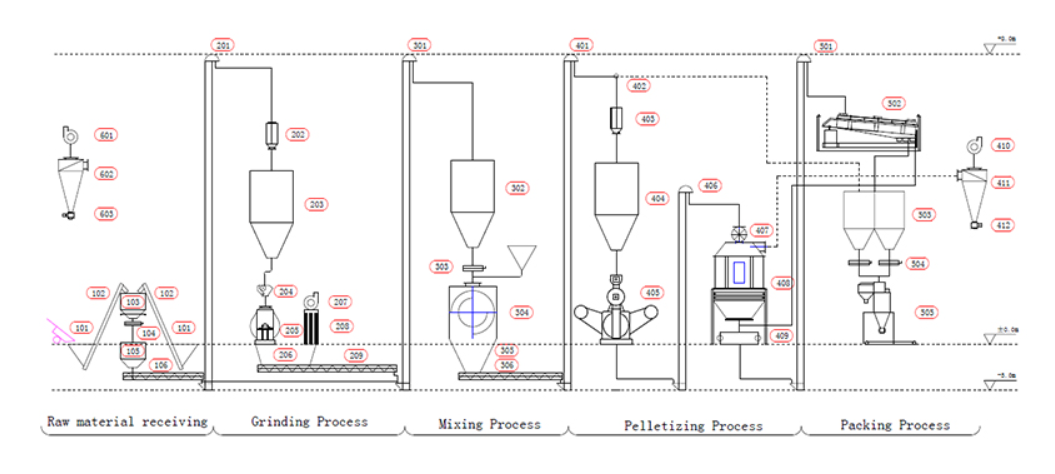
We provide a complete poultry and chicken feed production line from raw material intake to finished bagged pellets, with capacities ranging from 1 to 20 tons per hour. Our turnkey solution covers cleaning, grinding, batching, mixing, conditioning, pelletizing, cooling, crumbling, screening, and packaging—fully customizable to produce pellet feed or powder feed according to customer requirements.
Process Flowchart & Equipment Overview
| Stage | Equipment | Function |
|---|---|---|
| 1. Raw Material Receiving | Dump pit, bucket elevator, screw conveyor, steel silos | Receive and store corn, soybean meal, grains, and additives |
| 2. Cleaning Process | Drum screener, magnetic separator | Remove impurities (stones, metal, straw, dust) to protect equipment and ensure feed purity |
| 3. Grinding Process | Hammer mill / crusher | Reduce raw materials to optimal particle size for poultry digestibility |
| 4. Batching Process | Automatic weighing system, dosing screws | Precisely weigh each ingredient according to nutrition formula |
| 5. Mixing Process | Ribbon mixer / paddle mixer | Homogenize all ingredients uniformly; add liquids and micro-ingredients |
| 6. Conditioning Process | Steam conditioner / conditioner | Heat and moisturize mixed flour (70–90°C) for better pellet binding and sterilization |
| 7. Pelletizing Process | Ring die pellet mill | Press conditioned material through ring die to form dense, durable pellets |
| 8. Cooling Process | Counterflow cooler | Cool hot pellets (from ~80°C to near ambient), remove moisture, harden structure |
| 9. Crumbling Process (Optional) | Crumblers | Break large pellets into smaller crumbs for chicks and starter phases |
| 10. Screening Process | Vibrating screen | Remove fines and oversized pellets; recycle them back to the press |
| 11. Coating Process (Optional) | Liquid coating / sprayer | Apply enzymes, oils, vitamins for enhanced nutrition and palatability |
| 12. Packaging Process | Automatic packing scale, sewing machine, palletizer | Weigh, bag (25kg/50kg or custom), and palletize finished feed |
Key Specifications
| Parameter | Range |
|---|---|
| Capacity | 1–20 tons per hour (customizable) |
| Pellet Size | 1.0–12.0 mm (chick: 1–2mm, broiler: 3–4mm, layer: 4–6mm) |
| Final Product | Pellet feed or powder feed |
| Batching System | Automatic or manual |
| Packaging System | Automatic or manual |
| Applicable Feed Types | Broiler feed, layer feed, chick starter feed, poultry concentrate |
Key Value Proposition
| Benefit | Description |
|---|---|
| High Pellet Quality | Ring die pellet mill produces uniform, durable pellets with low breakage rate; improved feed conversion ratio (FCR) for poultry |
| Precise Formula Control | Automatic batching system ensures nutritional accuracy, reducing feed waste and improving flock performance |
| Energy Efficient | Optimized grinding and conditioning reduce power consumption; heat recovery design available |
| PLC Automation | Full automation from batching to packaging; minimizes labor requirement (3–4 operators per shift) |
| Flexible Configuration | Choose automatic or manual batching/packaging; customize for powder feed only or pellet feed production |
| Hygienic Processing | Steam conditioning kills Salmonella and other pathogens; ensures feed safety |
| Global Support | On-site installation, training, and after-sales service available |
Capacity Configuration Guide
| Line Capacity | Typical Power | Application |
|---|---|---|
| 1–3 TPH | ~100–150 kW | Small commercial feed mills, integrated farms |
| 3–5 TPH | ~150–250 kW | Medium-scale poultry feed factories |
| 5–10 TPH | ~250–400 kW | Large commercial feed plants |
| 10–20 TPH | ~400–800 kW | Industrial-scale poultry feed production |
Customization Options
Equipment configuration can be adjusted based on:
-
Feed type: Broiler, layer, breeder, or chick feed
-
Target capacity: 1–20 TPH
-
Pellet size: 1.0–12.0 mm
-
Final product: Pellet feed only, powder feed only, or both
-
Automation level: Manual batching/packaging to fully automatic PLC control
-
**Factory layout and space constraints
Who Benefits From This Solution
-
Poultry feed manufacturers seeking consistent quality and high output
-
Large-scale chicken farms integrating in-house feed production
-
Feed mill investors establishing new plants in developing regions
-
Existing feed mills upgrading capacity or product quality


