

Complete Animal Feed Production Line
Complete Animal Feed Production Line
We provide animal feed production line—from raw material intake to finished bagged feed—designed for stable output, formula flexibility, and scalable factory layouts. Our solutions cover poultry, cattle, pig, fish, shrimp, aquatic, and pet feed production , customizable to meet the needs of small farms, medium-sized factories, and large commercial feed mills.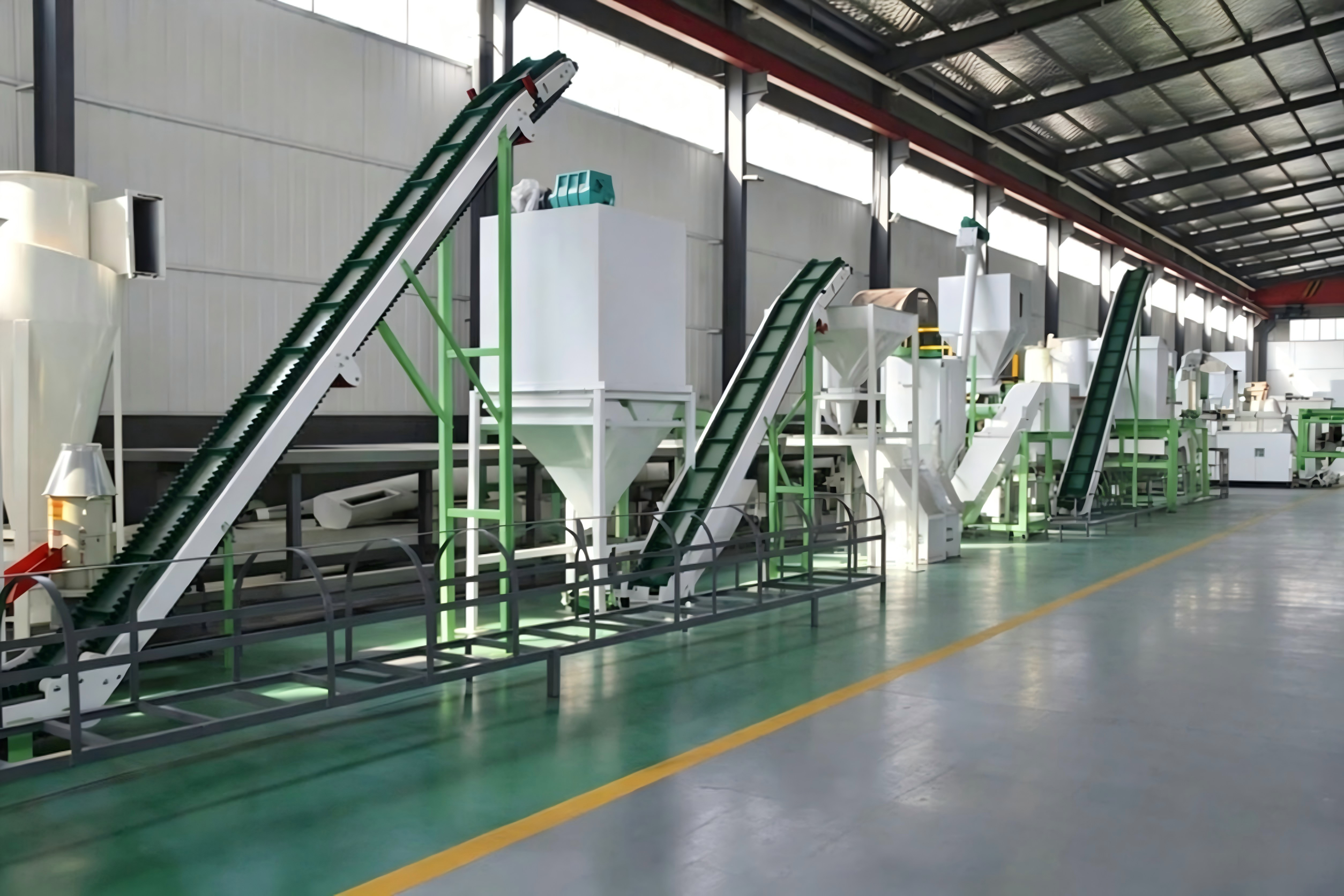
Process Flow & Equipment Overview
| Stage | Equipment | Function |
|---|---|---|
| 1. Raw Material Intake & Storage | Dump pit, pneumatic/mechanical conveyors, steel silos | Receive and store grains, soybean meal, corn, and other bulk raw materials |
| 2. Cleaning | Drum screener, magnetic separator | Remove wood, stones, iron, and other contaminants that damage equipment |
| 3. Grinding | Hammer mill, roller mill, disc mill, or multicracker | Reduce raw materials to desired particle size for optimal digestibility |
| 4. Dosing & Batching | Automatic weighing system, dosing screws, belt weighers | Precisely measure macro and micro ingredients per formula specifications |
| 5. Mixing | Ribbon blender or paddle mixer (single/double shaft) | Homogenize ground materials, additives, and liquids for uniform composition |
| 6. Conditioning | Steam conditioner | Heat and moisturize the flour mixture to improve binding and kill harmful bacteria |
| 7. Pelletizing | Ring die pellet mill or flat die pellet mill | Press conditioned mixture through die to form durable pellets (1–12mm sizes) |
| 8. Cooling | Counterflow cooler | Cool pellets, reduce moisture, and harden structure for storage/transport |
| 9. Crumbling (optional) | Crumblers | Cut pellets into smaller crumbs for young animals (chicks, piglets) |
| 10. Coating (optional) | Vacuum coater or liquid sprayer | Apply oils, enzymes, minerals, or flavor enhancers after cooling |
| 11. Screening & Grading | Vibrating screen | Remove fines and oversized particles; recycle them back to the press |
| 12. Packaging | Automatic packing scale, bagging system, palletizer | Weigh, bag, and palletize finished feed products |
Key Value Proposition
| Benefit | Description |
|---|---|
| PLC Automated Control | Full-process monitoring, automatic feeding, fault alarms; saves labor and reduces human error |
| High Pelleting Efficiency | High formation rate, uniform hardness, low breakage; can save 10–15% in operational costs |
| Flexible Configuration | Choose line capacity (500kg/h to 50t/h) and equipment based on feed type, pellet size, automation level, and factory layout |
| Wide Application Coverage | Poultry, chicken, pig, cattle, fish, shrimp, aquatic, and pet feed production |
| Energy & Cost Savings | Pre-sieving saves grinding energy; optimized grinding and conditioning reduce power consumption |
| Global Installation & Training | On-site installation or remote guidance + commissioning + production training provided |
Typical Line Configurations
| Configuration | Capacity | Power | Workers | Application |
|---|---|---|---|---|
| Simple Agricultural Line | 200–1,000 kg/h | ~60 kW | 2–3 | Small farms, medium commercial feed factories |
| Commercial Feed Line | 1–2 t/h | ~68.5 kW | 2–3 | Medium commercial feed factories, farms |
| Commercial Animal Feed Line | 3–5 t/h | ~178.5 kW | 2–3 | Large commercial factories (chicken, sheep, cow, shrimp) |
| Fully Automatic Line | 7–15 t/h | Custom | 4–5 | Large commercial factories, intelligent batching |
| Fully Automated Line | 15–20 t/h | Custom | 4–5 | Large-scale industrial production |
Customization Options
Equipment configuration can be adjusted based on:
-
Feed type: Poultry, livestock, aquatic, or pet feed
-
Target capacity: 200 kg/h to 200 T/h
-
Pellet size: 1–12mm (varies by animal type: aquatic 1–2.5mm, poultry 3–4mm, ruminants 6–12mm)
-
Automation level: Manual to fully automated PLC-controlled
-
Factory layout and space constraints
Who Benefits From This Solution
-
Feed manufacturers seeking stable output and formula consistency
-
Large-scale farms integrating in-house feed production
-
Aquaculture operations requiring water-stable, floating/sinking aquatic feed
-
Pet food producers needing extrusion-based production lines
-
Investors establishing new feed mill projects


